Tuesday, September 1, 2015

Misogyny, Eve and Khadija bint Khuwayl


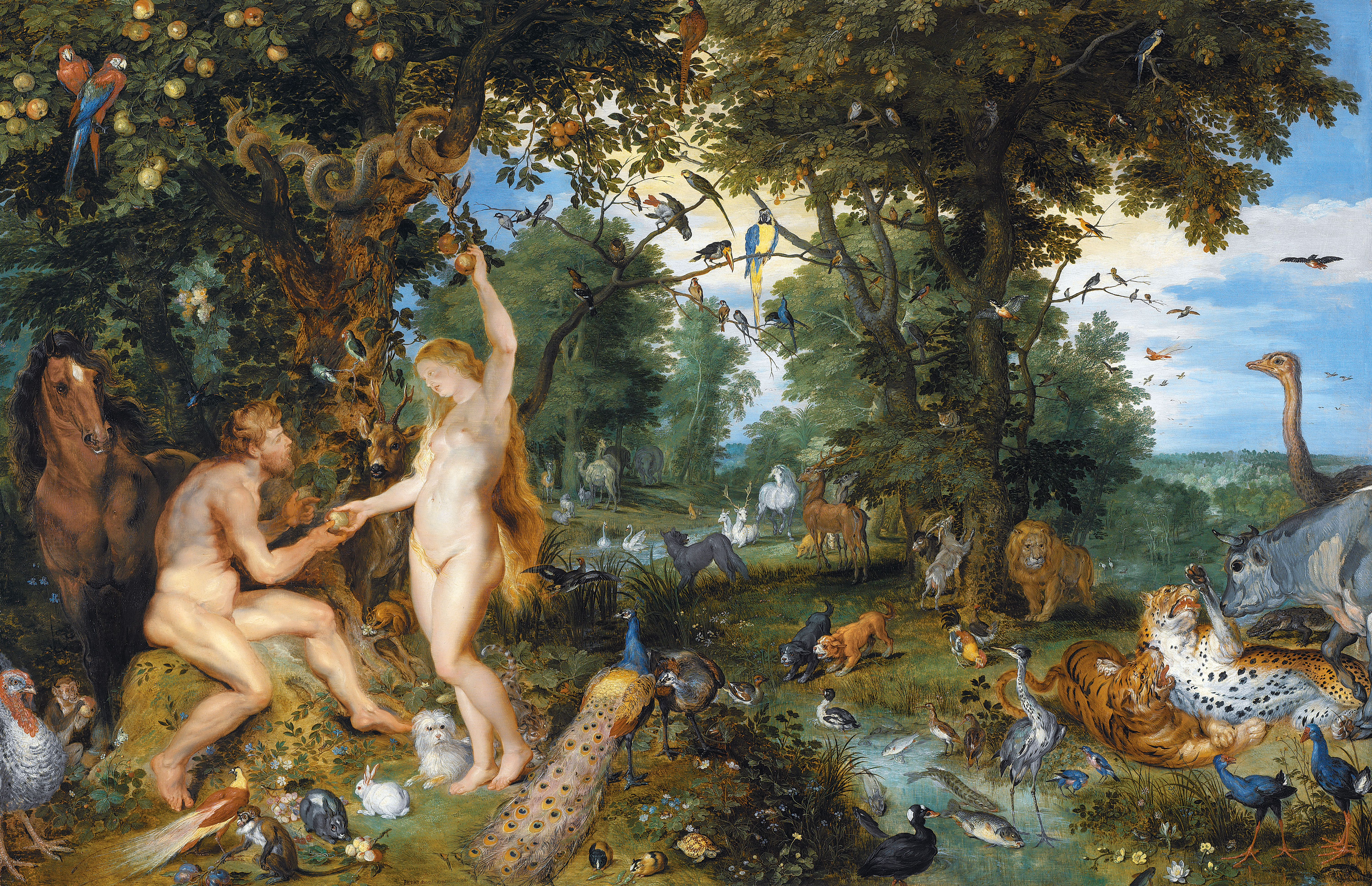
Most readers are familiar with the role played by the concept of original sin and the view of Eve in the history of Christian culture as it relates to Misogyny in "western" culture.
“The formalized doctrine of original sin was first developed in the 2nd-century by Irenaeus, the Bishop of Lyons, in his struggle against Gnosticism.  Irenaeus contrasted their doctrine with the view that the Fall was a step in the wrong direction by Adam, with whom, Irenaeus believed, his descendants had some solidarity or identity.  Irenaeus believed that Adam's sin had grave consequences for humanity, that it is the source of human sinfulness, mortality and enslavement to sin, and that all human beings participate in his sin and share his guilt” https://en.wikipedia.org/wiki/Original_sin
This concept would be tied to Eve's actions by Augustine, among others and well, the rest is literally history. 

The doctrine is not an element of mainstream Judiasm, wherein Adam and Eve’s punishment is tangible and immediate, including the loss of immortality for themselves and their descendants, having to work for a living, painful childbirth, fear of snakes, etc..

Islam also does not have original sin as an element. In Islam, the burden of a sin is born only by the sinner. But wait, there is more...


Khadija bint Khuwaylid

She was a 40 year old widow who became the young Prophet Muhammad's first wife and the first convert to Islam.
The tradition in many arab speaking Moslem countries of the laity having the Koran read to them, has given men a real leg up, and their own misogynistic edge.
 “Khadija became a very successful merchant. It is said that when the Quraysh's trade caravans gathered to embark upon their summer journey to Syria or winter journey to Yemen, Khadija's caravan equalled the caravans of all other traders of the Quraysh put together.”…Khadija entrusted a friend named Nafisa to approach Muhammad and ask if he would consider marrying. At first Muhammad was hesitant because he had no money to support a wife. Nafisa then asked if he would consider marriage to a woman who had the means to provide for herself. Muhammad agreed to meet with Khadija, and after this meeting they consulted their respective uncles. The uncles agreed to the marriage, and Muhammad's uncles accompanied him to make a formal proposal to Khadija.  It is disputed whether it was only Hamza ibn Abdul-Muttalib or only Abu Talib or both who accompanied Muhammad on this errand. Khadija's uncle accepted the proposal, and the marriage took place. “https://en.wikipedia.org/wiki/Khadijah_bint_Khuwaylid

Can you imagine a young woman in Afghanistan, who has learned to read, and decides to read a Koran? Talk about a WTF moment! 

Friday, August 14, 2015

strange women lyin’ in ponds dis¬trib¬utin’ swords is no basis for a system of government.*


"In recent years, psychologists have come to understand religion and paranormal belief as resulting, in most people, from simple errors in reasoning...."
http://www.huffingtonpost.com/matthew-hutson/all-paths-lead-to-magical-thinking_b_3942656.html

Also
" Once you’ve accepted that the brain constructs reality, and
that the brain has evolved like any other organ to help its owner survive
and reproduce, it follows that the brain constructs reality in the
most useful way possible for its owner. The key word here is useful,
which is not to say accurate. The brain doesn’t care so much what’s
really out there; it just needs to stay alive and be replicated, which
might involve telling us a white lie now and again."


 http://www.jeffsextonwrites.com/?s=magical

*  https://www.youtube.com/watch?v=dOOTKA0aGI0

Tuesday, July 28, 2015

A Brand of One


"The term branding has long been relegated to companies, but today almost every individual has a personal brand" http://www.forbes.com/sites/shamahyder/2014/08/18/7-things-you-can-do-to-build-an-awesome-personal-brand/

What was that called when i was a kid? Personality? Cannot remember. An interesting aspect of the ongoing commodification  of people.

" the blurring of the two entities - or are they even separate? With this sort of language play, a person's "character" is renamed as their "brand". 
An interesting article on the subject:  http://www.iasc-culture.org/THR/archives/Commodification/5.2EDavis.pdf


BTW: After reading the Joseph Davis paper (The Commodification of Self ) I think it may in the first 1/3 of the paper, have provided the best answer to the question; how did my counter-culture generation turn into the Generation of Swine?
Essentially, you take the 60's "rebellion" and leave its participants imbedded within the Economic Socially Obligate Boundary Condition...(that term is in my  "book", linked on the right...

"I am surprised and embarrassed to be part of the first American generation to leave the country in far worse shape than it was when we first came into it."
Hunter Thompson
  Well, at least i am not surprised anymore...

Wednesday, July 8, 2015

Thinking out loud about the use of the word “spirituality”


Courtesy of the folks at:


I am wrestling with my use of the term “spirituality”, as I use it in my personal writing, such as
In Air Water Ground (see link to document in the side bar), and in particular; and the post Human Socially Obligate Boundary Conditions and Related Cultural Universals http://airwaterground.blogspot.com/2015/07/human-socially-obligate-boundary.html  And  Regarding the Development and Fitness Value of Spirituality, http://airwaterground.blogspot.com/2015/03/regarding-thedevelopment-and-fitness.html
The definitions of spirituality are wide, varied and unsettled. They range from the the plethora of  “new age” views to the newer secular variants, such as in the writings of  Ursula Goodenough or Sam Harris .

The term religion is I think, much simpler to define. My take on that is that it:

Is a term denoting a group of individuals

That group self identifies around a spiritual schema

Exhibits expression of the Pseudospeciation Socially Obligate Boundary Condition (PSOBC)

Exhibits expression of the Vertical Dominance Hierarchy Socially Obligate Boundary Condition (VSOBC)

I am wondering if I should substitute for spirituality a term such as superstition or supernatural. This would thereby exclude / clarify that the secular spirituality concepts such as those expressed by Ursula Goodenough /Sam Harris are not included.

My reason for using spirituality as I do is simply, its etymological roots.  Which for my purposes, seems well, appropriate.
“The term spirit means "animating or vital principle in man and animals". It is derived from the Old French espirit which comes from the Latin word spiritus (soul, courage, vigor, breath) and is related to spirare (to breathe). In the Vulgate the Latin word spiritus is used to translate the Greek pneuma and Hebrew ruah.  …The term "spirituality" is derived from Middle French spiritualité, from Late Latin "spiritualitatem" (nominative spiritualitas), which is also derived from Latin spiritualis.”   https://en.wikipedia.org/wiki/Spirituality , citations omitted.

Supernatural, given the very existence of the concept, may be a better term for my use? “The supernatural (Medieval Latin: supernātūrālis: supra "above" + naturalis "nature", first used: 1520–30 AD) is that which is not subject to the laws of physics or, more figuratively, that which is said to exist above and beyond nature.” https://en.wikipedia.org/wiki/Supernatural citation omitted

Or perhaps superstition? It is perhaps too narrow of a term for my application? “Superstition is the belief in supernatural causality—that one event causes another without any natural process linking the two events—such as astrology, religion, omens, witchcraft, prophecies, etc., that contradicts natural science.” https://en.wikipedia.org/wiki/Superstition

Monday, July 6, 2015

Human Socially Obligate Boundary Conditions and Related Cultural Universals


"In this animation, the vertical direction indicates time and the horizontal direction indicates distance, the dashed line is the spacetime trajectory ("world line") of the observer. The lower half of the diagram shows the events that are "earlier" than the observer, and the upper half shows events that are "later" than the observer. The small dots are arbitrary events in spacetime."


 Will be included in Air Water Ground at a later date.

Draft


Human Socially Obligate Boundary Conditions and Related Cultural Universals
Jay Moynihan 07/05/2015                                                                             

The Cultural Universals are from:
The Evolution of Childhood  Relationships, Emotion, Mind, Melvin Konner, The Belknap Press of
Harvard University Press, (2010)
Human Universals... compiled by Donald E. Brown
..as published in The Blank Slate by Steven Pinker, 2002, New York: Viking Press
Brown, D.E. 1991. Human universals. New York: McGraw-Hill
Note: Socially Obligate Boundary Condition is A set of social parameters or conditions that evolved in a specie, that limits its behavior at a given point in space time. May change in adaptation to changing conditions, including social conditions. Jsm, Air Water Ground .

Pseudospeciation Socially Obligate Boundary Condition (PSOBC)

Extra-genetic transmission of language
Kin Terms (language)
Binary conceptual discrimination (language)
Historic linguistic change
Childhood physical aggression (more so in males)
Recognition of individual faces
Sense of distinctive peoplehood
Relatives distinguished from non-relatives
Conflict at individual & group levels
Ethical dualism; different rules for in-group/out-group
Belief in supernatural entities
Territoriality
Historical & origin narratives
Dispersal of groups
Discrimination (pseudospeciation )
Fear of strangers
Negative identification of us/them
Cultural construction of perception (collective assimilation)
Sense of self as subject/object

Vertical Dominance Hierarchy Socially Obligate Boundary Condition (VSOBC)

Kin Terms (language)
Division of labor by sex and age
Females attracted to powerful males
Male abuse of power
Ascribed & achieved status role beyond age, sex, kinship
Perscription off behaviors
Belief in supernatural entities
Crime
Mimicry
Moral sentiment
Leaders
Defacto oligarchies
Collective decision making
Territoriality
Inheritance rules
Nepotism
Cultural construction of perception (collective assimilation)
Cultural coherence (overarching themes)

Status Socially Obligate Boundary Condition (SSOBC)

Childhood Physical aggression (males more so in males)
Play fighting
Division of labor by sex and age
Females attracted to powerful males
Male attraction to nubile females
Ascribed & achieved status role beyond age, sex, kinship
Cultural coherence (overarching themes)
Cultural construction of perception (collective assimilation)
Symbolism
Defacto oligarchy
Territoriality
Sense of self as subject/object

Economic Socially Obligate Boundary Condition (ESOBC)

Reciprocity, exchanges, cheating
Personal Property
Cultural construction of perception (collective assimilation)
Symbolism
Cultural Schematization
Abstract thought
Trade
Sense of self as subject/object
Systemic, varied tool making
Reciprocal exchange
Turn taking

I am toying with recognizing spirituality as a SOBC.?

IF Spirituality Socially Obligate Boundary Condition (SPSOBC)

Belief in supernatural entities
Symbolic thought
Sense of self as subject/object
Abstract thought
Cultural Schematization
Cultural construction of perception (collective assimilation)
Rituals
Fear of death
Death rituals/mourning
Dream interpretation
Beliefs about death
Narratives
Historical & origin narratives
Moral sentiment
Consciousness altering substances
Belief in life after death
World view
Anthropomorphization
Culture / nature distinction

Note:
Does religion = one of our species’s expressions of {  SPSOBC+ VSOBC + PSOBC + ESOBC } ?


Friday, July 3, 2015

The Republic's Swan Song?


Is he our Cicero? Hopefully his hands will not be nailed to the doors of the senate. Senator Bernie Sanders, speech on 07/01/2015.
https://berniesanders.com/news/live-madison-wisconsin/

Wednesday, June 17, 2015

Cafeteria Abrahamics, or, Laudato Sii Dominus

Adam naming the animals of the world, Peterborough Bestiary ( 14th Century)

Tomorrow's publication by the Vatican of Pope Francis's encyclical, Laudato Si , is already caused a spinfest in the media. Apparently it is in part a faith based call to action on matters "environmental", including the current period of anthroprogenic rapid climate change. Those who may be loosely lumped under the category environmentalist are hoping it sways the political conversation about climate change in the United States their way, while those in the opposing camp are girding their loins for the coming battle.

On the mundane level, i look forward to seeing the "right-wing" folks who for years have hurled the epithet Cafeteria Catholic at the "left-Wing", being hoisted by their own petard. 

Also, i welcome anything that helps my fellow surviving members of the genus Homo come to terms with the necessity of mitigating, or at least, planning adaptation to, rapid climate change. Any port in a storm, as the saying goes.

Granted, this looming philosophical dust up could (probably will?) subsume into the spin cycles of American public "discourse". But a subsidiary point i would like to make in this post is, Could this result in schism in the Catholic Church in the United States? 
The other friction points between American Catholics and the Vatican are pretty much questions akin to how many angels can dance on the head of a pin (homosexuality, abortion yada, yada) and can be either ignored by individuals or used to stir up the folks in Short Attention Span Theatre for one's own funding and electoral ends. But damn! This new thing from the Vatican is important. I mean it has to do with making money!
We should not forget the contingent rise of Protestantism and the European concept of middle class, and the beginnings of the market economics. Protestantism was a bargain for business folks (sol fide, no more indulgences, The Calvinist linking of wealth and grace, etc.). But i digress. To the main topic of this post.

Cafeteria Abrahamics?

As Hannah Arendt among other pointed out, there is a near universal tendency in humans to found the legitimacy, and resultant authority of an idea or belief on it being old in origin, or being founded in the time of perceived origin. This trope, along with the logical fallacy of appeal to authority, are the primary buttresses of all arguments founded on a "scripture". But such is not limited to the religious realm. I remember the humorous assertions in the 1970's of vegans (we, a specie with the dental structure of an omnivore were originally vegetarian) and some feminists (we, a specie that is gender dimorphic with the males larger were originally in cultures that were female dominate or gender neutral) that illustrate that this tendency is not limited only to the religious.

This is often a necessary recourse for modern devotees of one of the Abrahamic faiths. The Age of Reason, The Enlightenment and the rise of scientific thought created a modern morality the decreased the barbarous behaviors in history of those professing belief in one of the Abrahamic faiths. 

The majority of these modern believers would no longer condone the vast majority of the recommended behavior found in Exodus, Deuteronomy, Leviticus etc. A child or adult who tended towards those beliefs now would be considered by a majority of Abrahamics in need of rapid intervention and some serious counseling. The ones that do not feel that way, tend to populate the various "Talibans" (politically right wing fundamentalist Christians, Jews, Muslims etc.) around the world. 

The various Talibans do not exhibit much concern over environmental matters generally or rapid climate change in particular, being wrapped up in their respective struggle with the satanic _________ (insert appropriate group(s)/people) and often seem be in some sort of rapturous anticipation of the "end times"* at which the satanic _________(insert appropriate group(s)/people) will get what coming to them.

But for those of the Abrahamic Faithful who are comparatively housebroken, that learned the principles of The Enlightenment with their mother's milk, you have "Stewardship Theology"

But i wager that Stewardship Theology is (though again, I say thanks the god(s) it exists!) another attempt to not have to credit correctness or authority to a newish idea or concept. In essence, it is a another beneficial example of Abrahamic Cafeteriaism.

The source for the following excerpts, unless otherwise noted, is the JPS Hebrew - English Tanakh, edition, Jewish Publication Society (2nd Edition 1999)

Genesis 1:24-30:
" ...And God said, let us make man in our image, after our likeness. They shall rule the fish of the seas, the birds of the sky, the cattle, the whole earth, and all creeping the things that creep on earth. [after one of the descriptions of the creation of man & woman]...And God said to them, be fertile and increase, fill the earth and master it; and rule the fish of the sea, the birds of the sky, and all things that creep on earth. And God said, see, I give you every seed bearing plant that is upon all the earth, and every tree that has seed bearing fruit, they shall be your food. And to all animals on the land, to all the birds of the sky, and to everything that creeps upon the earth, in which there is the breath of life , I give all the green plants for food."

Genesis 3:19-20
And the Lord formed out of the earth all the wild beasts and all the birds of the sky, and brought them to man to see what he would call them; and whatever the man called each living creature that would be its name. And man gave names to all the cattle and to the birds of the sky, and to all wild beasts."

"A common concept in history is that knowing the name of something or someone gives one power over that thing or person. This concept occurs in many different forms, in numerous cultures—in ancient and primitive tribes, as well as in Islamic, Jewish, Egyptian, Vedic, Hindu, and Christian traditions. The strength of this belief varies, and there are certainly exceptions to it. Nonetheless, the persistence and historical continuity of the linking of naming and power are unmistakable. Some scholars find it embedded in the first verses of Genesis, probably written over three thousand years ago; others believe it to be an intrinsic characteristic of classical Greek religion; still others find it a central feature in magic and folklore; and modern feminists often see it as the reason that a woman in marriage is traditionally asked to take the name of her new husband. In all these cases, naming something or someone is seen as the exertion of dominion over that thing or person."

Some fans of the Film Noah may interpose at this point, but hey, the rules changed after the flood, didn't they? Please turn to Genesis 9 1-3:

"God blessed Noah and his sons, and said to them, be fertile and increase and fill the earth. The fear and dread of you shall be upon all the beasts of the earth and upon all the birds of the sky, everything with which the earth is astir, and upon all the fish of the sea; they are given to your hand."

So where in the "good book" can one hang their stewardship hat? Nowhere.
Well, apart from the later, post-biblical teaching in the middle ages of Francis of Assisi (most fun ways to learn about this are here and here , the later having much better acting etc.) and various mystical tradition such as Sufism.

Perhaps the "steward" from this, given that word  "steward" in the archaic, could be the manger of farm or vineyard labor.
Genesis 2: 15:
"The Lord God took man and placed him the garden of Eden to til it and tend it."

*My favorite End Times